
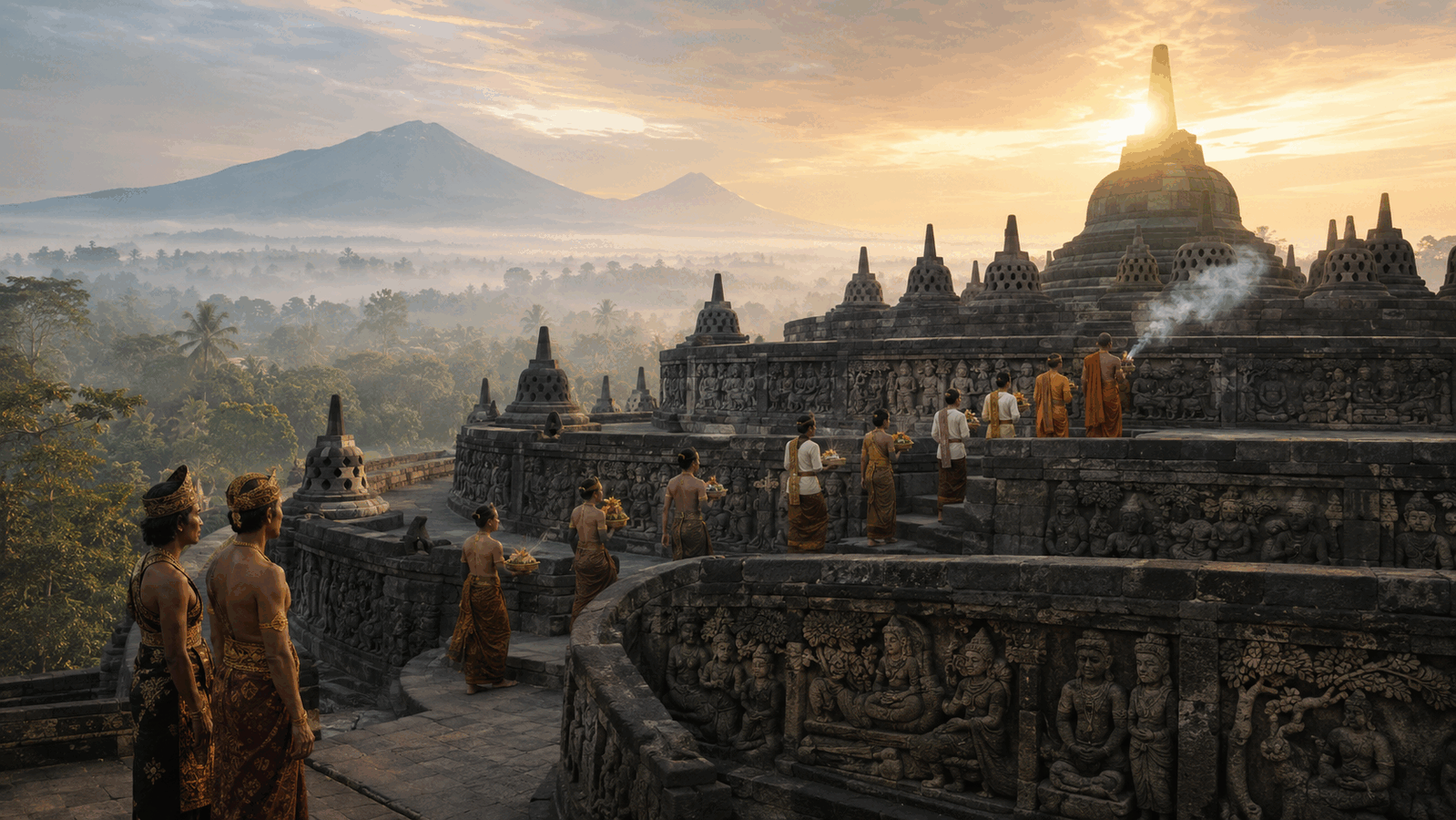
The Borobudur Temple Original Purpose explains why this extraordinary Buddhist monument was created in ancient Java. Located in Central Java, Indonesia, Borobudur was built as more than a historical structure. The temple represented a sacred place for meditation, learning, and spiritual development.
Constructed during the Sailendra Dynasty around the 8th and 9th centuries, Borobudur reflected the influence of Mahayana Buddhism in Java. Its design combined religious symbolism, architectural knowledge, and cultural values from ancient Javanese society.
A Sacred Monument for Buddhist Practice
The main purpose of Borobudur was to support Buddhist spiritual activities. The temple served as a place where monks and pilgrims could meditate, study Buddhist teachings, and follow a symbolic journey toward enlightenment.
Unlike traditional temples with a central worship chamber, Borobudur was designed as a walking pilgrimage route. Visitors moved through galleries and terraces while reflecting on Buddhist lessons.
The structure guided people from the lower levels toward the highest terraces. This movement represented the gradual process of achieving spiritual awareness.
Visitors can learn more about the temple’s history through Borobudur Temple history, origins, rediscovery, restoration, and legacy.
Symbolic Meaning of Borobudur Architecture
Borobudur’s design follows Mahayana Buddhist cosmology. The monument consists of three main sections: Kamadhatu, Rupadhatu, and Arupadhatu.
Kamadhatu represents the world of human desires and attachments. This level describes the challenges people experience before reaching higher spiritual understanding.
Rupadhatu represents the transition between the physical world and spiritual development. The galleries contain detailed relief panels that explain Buddhist teachings and moral values.
Arupadhatu represents the highest spiritual stage. The circular terraces and stupas symbolize freedom from worldly desires and the achievement of enlightenment.
A Center for Learning and Pilgrimage
Borobudur also functioned as a center for Buddhist learning. Monks and visitors traveled to the monument to gain knowledge and practice meditation.
The temple reliefs played an important educational role. Thousands of carvings displayed Buddhist stories, ethical lessons, and examples of spiritual transformation.
The relief panels included stories from Buddhist texts such as Lalitavistara and Jataka tales. These artworks helped communicate religious teachings to visitors.
Connection Between Religion and Royal Power
Construction of Borobudur also reflected the influence of the Sailendra Dynasty. The rulers supported Buddhist traditions and used monumental architecture to demonstrate their cultural achievements.
The temple represented the connection between political authority and religious devotion. Its enormous scale showed the resources and skills available during the ancient Javanese period.
Borobudur became a symbol of both spiritual belief and royal dedication.
Decline and Modern Preservation
Over time, Borobudur lost its original function due to political and cultural changes in Java. The monument was gradually abandoned and covered by volcanic materials and vegetation.
After its rediscovery in the 19th century, researchers and conservation experts worked to protect the temple. Restoration projects preserved its architecture and historical value.
Today, Borobudur remains an important Buddhist heritage site. Travelers from around the world visit the monument to understand its history and meaning.
Visitors who want to explore this ancient masterpiece can join a Borobudur Temple tour to discover its architecture, cultural background, and spiritual significance.
Conclusion
The Borobudur Temple Original Purpose was to create a sacred environment for Buddhist meditation, learning, and spiritual transformation. Every terrace, relief, and stupa carries a deeper meaning connected to the journey toward enlightenment.
Understanding its original purpose allows visitors to appreciate Borobudur beyond its physical appearance. The monument represents the creativity, devotion, and knowledge of ancient Javanese civilization.

Tinggalkan Balasan