
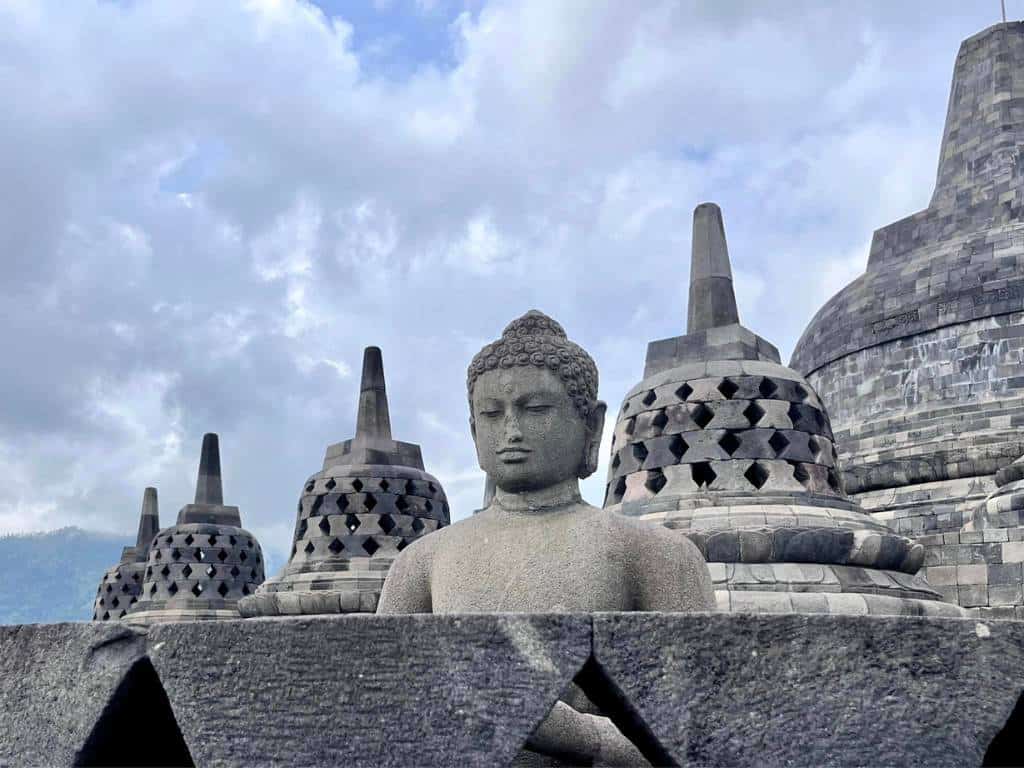
The Borobudur Temple relief facts reveal an important part of this ancient monument’s artistic and cultural heritage. The stone walls contain thousands of carved scenes that combine Buddhist teachings with depictions of people, animals, buildings, nature, and everyday activities. These reliefs make the galleries more than architectural pathways because they also create a visual journey through stories and ideas.
Reliefs Cover the Temple Galleries
One of the most notable features of Borobudur is the large number of relief panels incorporated into its architecture. Visitors can find them along the walls and balustrades of the square terraces.
The carvings appear at various levels and follow the pathways around the monument. As visitors walk through each gallery, they encounter scenes arranged across the stone surfaces.
This design allows the reliefs to become part of the physical experience rather than functioning as separate artworks.
Buddhist Stories Appear in the Carvings
Many reliefs portray stories connected with Buddhist teachings. The scenes can illustrate ideas about morality, compassion, human behavior, and the consequences of actions.
Characters appear in various settings, often surrounded by architectural and natural details. These elements help create complete scenes rather than isolated figures.
The reliefs therefore served as a visual method for presenting stories to people who encountered them while moving through the monument.
The Reliefs Also Show Daily Life
Another interesting aspect of the Borobudur Temple relief facts is the representation of everyday life. The carvings include people wearing various types of clothing, using transportation, interacting with one another, and participating in various activities.
Artists also included houses, ships, plants, animals, and other objects.
These details provide valuable visual information about the world represented by the ancient artists. They also make the reliefs interesting to visitors who want to look beyond the religious narratives.
Ancient Artists Worked Directly With Stone
Creating the reliefs required skilled craftsmanship. Artists carved the scenes directly into stone surfaces and carefully shaped figures, objects, patterns, and backgrounds.
The compositions contain various levels of depth. Some elements stand prominently from the surface, while smaller details remain closer to the background.
This technique gives many scenes a sense of dimension and allows individual figures and objects to remain visually distinct.
For travelers who want to learn more about Borobudur’s history, architecture, Buddhist meaning, and other interesting details, this Borobudur facts guide provides a broader overview.
The Reliefs Follow the Temple’s Structure
The reliefs are closely connected with Borobudur’s architectural organization. Visitors encounter them while moving around the square terraces before reaching the circular platforms above.
This arrangement creates a clear difference between the lower and upper sections. The lower galleries contain extensive narrative artwork, while the upper platforms focus more strongly on stupas and open architectural space.
The changing amount of decoration contributes to the sense of progression throughout the monument.
Reliefs Make Borobudur a Visual Journey
The Borobudur Temple relief facts show how closely architecture and storytelling work together. Visitors do not simply stand in front of the carvings. They move along the galleries and encounter one scene after another.
This movement gives the reliefs a unique role in the overall experience. The monument combines physical exploration with visual storytelling.
Why the Reliefs Matter Today
The reliefs remain one of the most valuable features of Borobudur. They preserve artistic details while providing insight into Buddhist traditions and the world represented by ancient Javanese artists.
Travelers who want to visit Borobudur and other destinations around Central Java can also explore Borobudur Tours.
Taking time to examine the carvings can reveal details that are easy to miss during a quick visit. From Buddhist stories to scenes of daily life, the reliefs demonstrate the remarkable ability of ancient artists to turn stone walls into an extensive visual narrative.

Tinggalkan Balasan